
Radial Phenomenon
Rethinking nature – from infinity to the circle. An introduction to closed intuition.

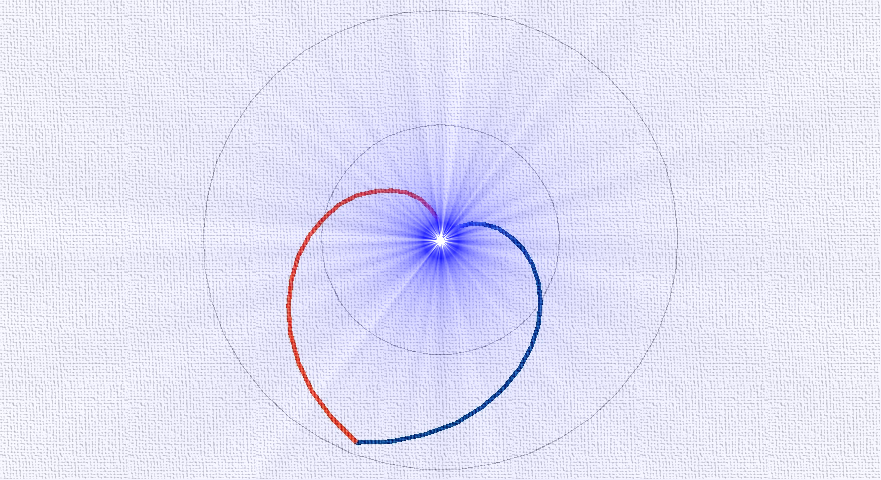
Foreword
This book is not written for mathematicians.
It is not written for physicists.
It is written for people who want to see.
It contains no new discoveries.
It contains no new formulas.
It contains only an old circle – and the question:
What happens when you put numbers on its axes and connect the points?
The answer is so simple that it was overlooked:
You can see nature.
You see a heart. A spiral. A falling drop.
You see an hourglass. A double heart. A counter-vortex.
You see the order of the planets. The discharge of the Big Bang. The whisper of dark matter.
No formula. No derivation. No calculator.
Just a circle, numbers, and the courage to look.
The scientists will tap their heads.
That’s their job.
But you – you sit down with a compass, a sheet of paper, and a pen.
You put numbers in the circle.
You connect the points.
And you look.
You don’t even need a compass. Spreadsheet programs offer pie charts.
Then you know what this book wants to show you:
Nature is not a calculation. Nature is a radial phenomenon.
One request before reading:
Forget for a moment what you’ve learned about units, constants, and formulas.
Forget meters, kilograms, and seconds.
Forget that the center must be zero.
Just imagine a circle – and the possibility that any number can appear on its axes, positive or negative, large or small.
Introduction: The major distinction
Linear diagram (Cartesian)
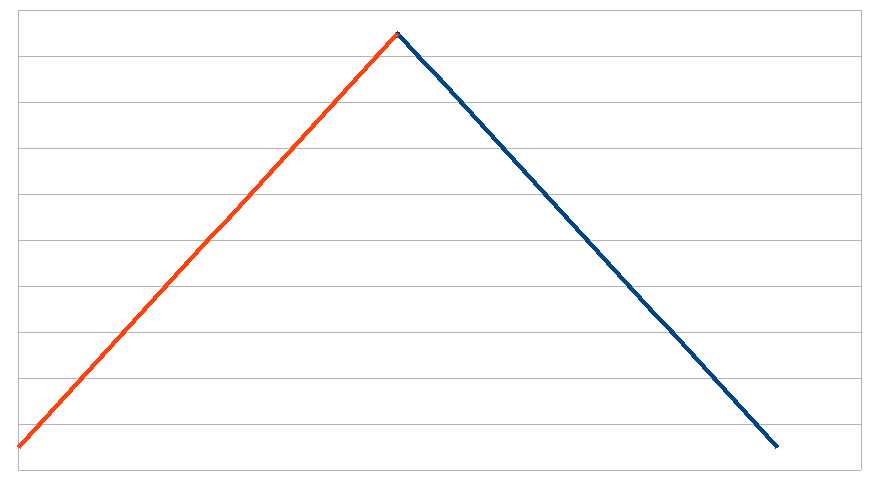
Open, infinite
No natural beginning, no natural end
You can always go further to the right or up.
Unimaginable (10³⁰? 10⁻³⁴?)
Formulas as crutches
The scientists are at home
Pie chart (radar chart)
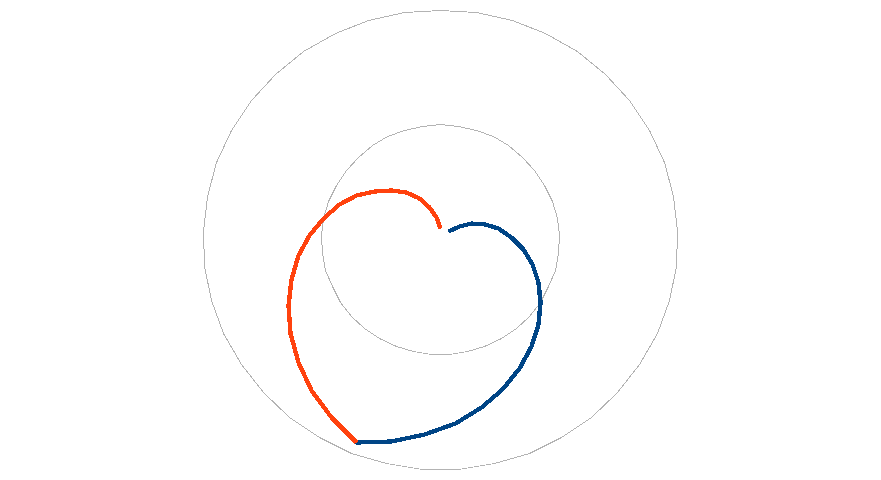
Closed, finally
The center and edge are clear
You reach the edge of the circle.
Conceivable (everything between -12 and +12)
Forms as a visual representation
Those who can see are at home
The linear diagram is the method of infinity – powerful in its calculations, but abstract. The circle is the method of the imaginable – closed, manifest, visible.
Part I: The Basics
Chapter 1: Introduction
Why the linear diagram is no longer sufficient for us
The linear diagram is open, infinite, unimaginable.
You can always go further to the right or upwards – but no human being can truly grasp 10³⁰ or 10⁻³⁴.
Formulas become crutches for the unimaginable.
The search for the closed shape: What if you bend the axis into a circle?
First steps: 1-9 connected in a circle – a spiral appears.
First insight:
The linear diagram is the method of infinity. The circle is the method of the imaginable.
Chapter 2: The Tool
The radar chart as a stage for radial phenomena
2.1 Structure
A circle, many axes (4, 8, 12, 24, 200…), a center , a boundary .
Each axis is a number line, but arranged radially.
2.2 The center is not zero
Previously, it was thought that the center is 0, and everything positive lies between the center and the edge.
But: The center can also be negative.
The middle is not the smallest value – it is the turning point , the pole where the sign changes.
Positive values: from the center outwards to the edge.
Negative values: from the center outwards to the opposite side – through the middle.
2.3 The consequence for demonstration
The circle is no longer seen as a disk, but as a projection surface of an axis that passes through the center .
Radial phenomena can occur on one side of the center – or on both.
In the latter case, piercing shapes are created : hourglass, figure eight, loop.
2.4 The number range
We work by rearranging the units/natural constants to a 12-1-1 system. The speed of light c of 300,000 m/s is set to 12: c = 12, G = 1, ħ = 1.
This trivially reduces E=mc² to E=144m
All numbers from -12 to +12 are allowed.
0 is not the middle – the middle is the point where the sign changes.
Second insight:
The center is not zero. The center is the pole where the sign changes. The circle becomes the locus of polarity.
Chapter 3: The Basic Rule of Forms
Equal numbers – unequal numbers
Identical numbers on regularly distributed axes result in regular shapes: circle, polygon, star.
Unequal numbers result in irregular, organic shapes.
Symmetrically unequal numbers (such as 1-9-1) result in symmetrical organic shapes: heart, drop.
Mixing positive and negative values results in piercing shapes.
Third insight:
The number determines the form. Like attracts like. Unlike attracts its own. The change of sign results in the penetration.
Part II: The Manifestations
Chapter 4: The first radial phenomena (positive values only)
Number sequence in diagrams
phenomenon
Meaning
1, 2, 3, 4, 5, 6, 7, 8, 9 (monotonically increasing)

Spiral in the pie chart
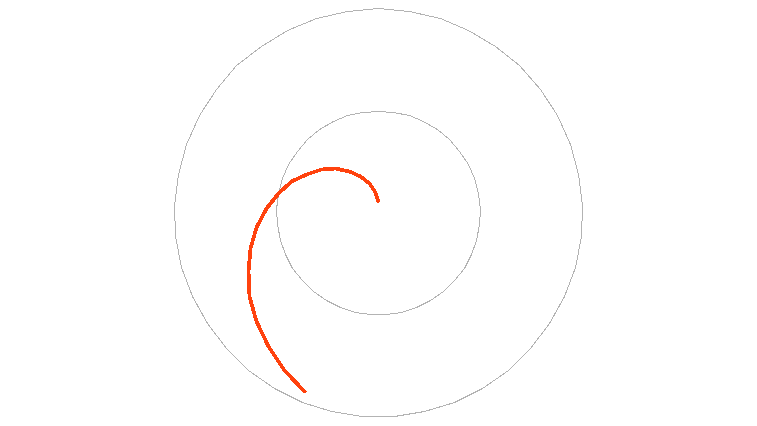
Growth, turbulence, life
1-9-1 (ascend + fall)
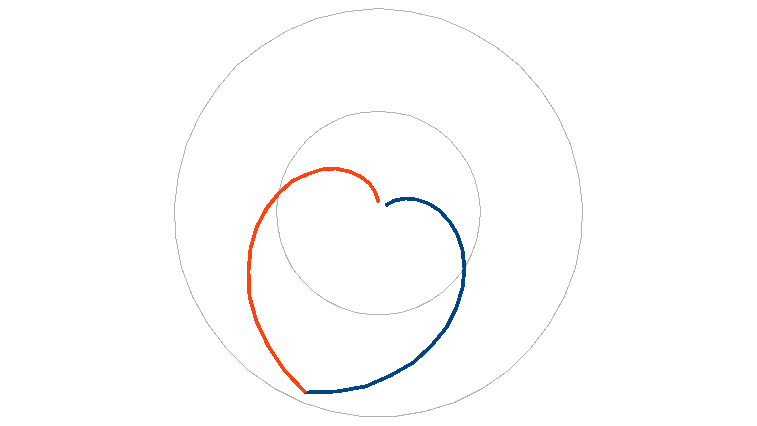
Heart
Relationship, breathing, love as a form
Four identical packages + 0
Maltese Cross
In the linear world, it is a “frequency” with a short duration and a fall to zero.
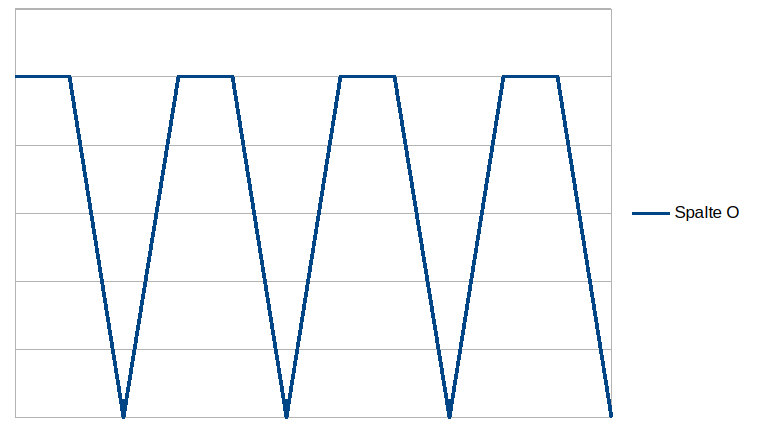
In the radial world, it is the Maltese cross. But not only the Maltese cross, but also the outer surfaces of a pyramid.
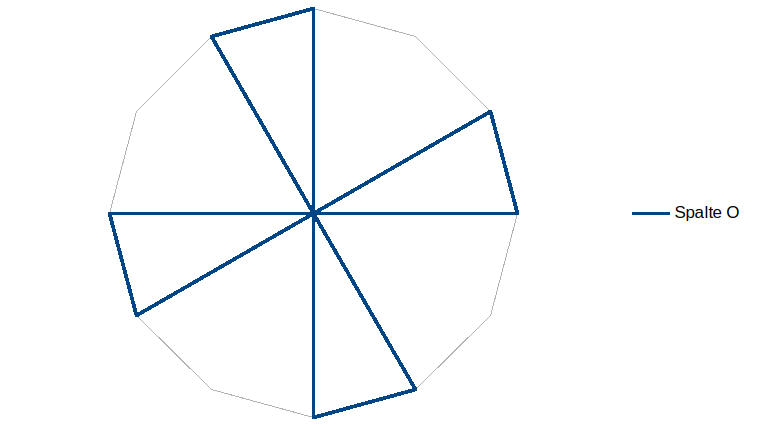
Order, polarity, cardinal directions
Gaussian normal distribution
Water droplet / Flame / Egg
Gentle accumulation, fall and rise
0,1,0,1,0,1…
Star / halo
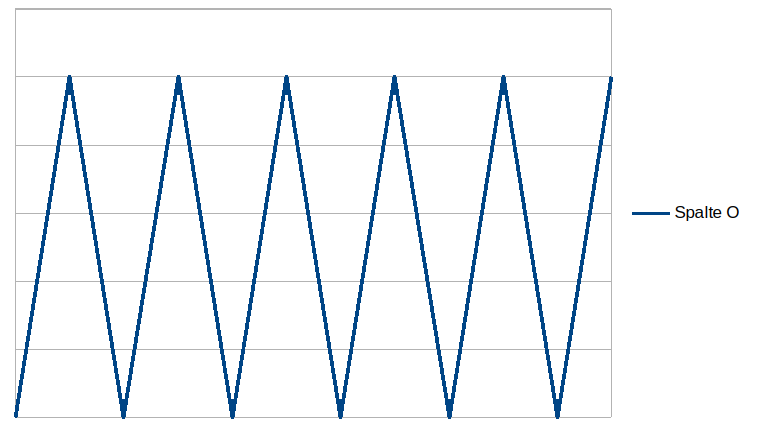
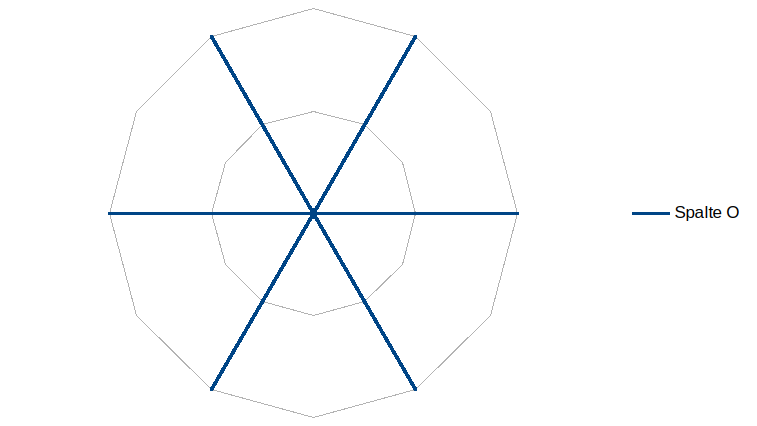
Diffraction around light sources. This star pattern of light rays can be seen when looking at a light source, such as the sun. The zigzag pattern in the linear world corresponds to the electromagnetic wave, i.e., light. But here too, if we look to the past, we find the Hagal rune.
Fourth insight:
Every natural form has a tangible radial phenomenon. You just have to place it and see it.
Chapter 5: Piercing Shapes (positive and negative values)
5.1 The principle
If you assign positive values to one half of the axes and negative values to the other half, shapes are created that pass through the middle .
The middle is no longer experienced as a boundary, but as a passageway .
5.2 Examples
sequence of numbers
phenomenon
Meaning
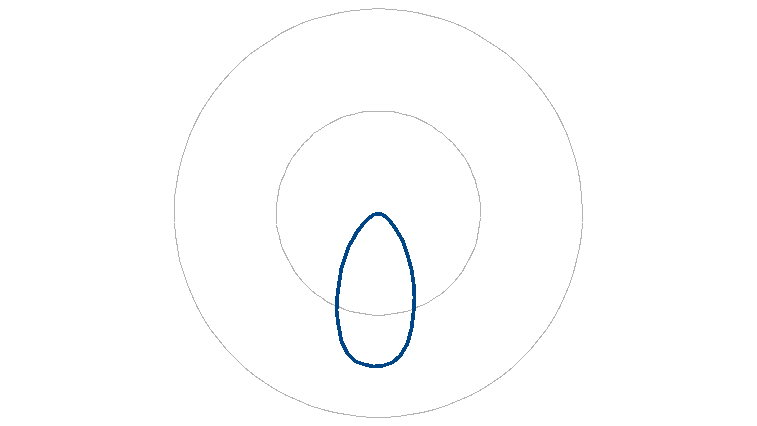
Gaussian curve
The Gaussian curve, i.e., statistical normal distribution, results in the shape of a water droplet, flame, egg in a pie chart.
Double heart / butterfly
Two halves of a heart touching at the top
Positive spiral (1–9), negative spiral (-1 to -9)
Counter-rotating double spiral
Vortices and counter-vortices – the structure of turbulence
0,1,0,1 (positive) and 0,-1,0,-1 (negative)
Eight-pointed star
A star that continues through the middle
Fifth insight:
The center is not a boundary. It is the point where positive and negative meet. Every penetrating form is a polarity expressed in the circle.
Chapter 6: The Discovery of Unitlessness
Why meters, kilograms, and seconds deceive us
The problem: Fundamental constants are either huge or tiny – unimaginable.
The solution: A new system of units that places all constants between -12 and +12 .
The 12-1-1 system : c = 12, G = 1, ħ = 1.
Consequence: E = 144m, r_s = M/72, F = m₁m₂/r².
The units are discarded – only pure numerical ratios remain.
Negative energies? Negative masses? Allowed in the radial phenomenon – they appear as mirrored forms on the other side of the center.
Sixth insight:
Nature is neither huge nor tiny. It has simply been measured incorrectly. And it knows no absolute zero points – only poles of sign change.
Chapter 7: The Logarithm as a Natural Scale
How the sun fits into the circle
Even in the 12-1-1 system, some values are still too large (Sun, Galaxy).
Solution: The logarithm – of course, because nature thinks in proportions (ear, eye, growth).
Logarithmic scale from -12 to +12: We choose the pole at 0 as the inflection point.
Sun ≈ 7.46, Universe ≈ 12, Planck mass ≈ -12 (or 0, depending on the definition).
All celestial bodies become visible, comparable, imaginable – and can appear positive or negative, depending on the point of reference.
Seventh insight:
The logarithm is the bridge between the unimaginable and the circle. And the pole of the scale is the point where the sign changes. Logarithms are natural. Our ears work according to logarithms. So do our eyes.
Chapter 7: The Planetary Order – A Spiral in a Circle
How the logarithm makes the music of the spheres visible
7.1 The problem of linear representation
The average distances of the planets from the Sun (in Astronomical Units, AU):
planet
Distance (AU, Astronomical Units)
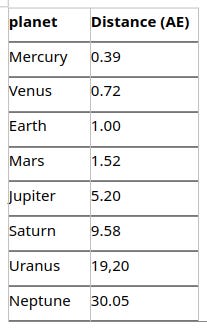
In a linear diagram:
a confusing sequence – Mercury, Venus, Earth, Mars close together, then a huge leap to Jupiter, Saturn, Uranus, Neptune. No one sees a pattern in it.
The established theory speaks of a “Titius-Bode sequence,” a somewhat fitting numerical sequence, but one that has no deeper meaning.
7.2 The logarithm as a natural scale
planet
Nature thinks in ratios, not differences.
Therefore, we take the base-10 logarithm of the distances.
These values are now more evenly distributed – and can easily be scaled to the circle range 0–12 (e.g. by multiplication by 8 and addition of a constant).
All values are now between 0 and 12 – perfect for the circle.
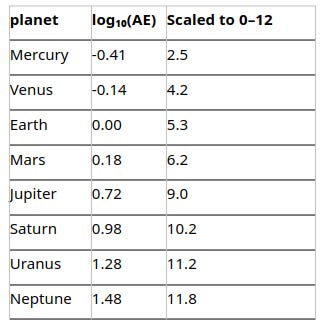
7.3 The Radial Phenomenon
If these 8 values are placed on 8 evenly spaced axes (45° steps) and connected sequentially, a clear, recognizable figure is created :
A steep ascent from Mercury to Earth (the inner planets)
A gentle curve from Earth to Jupiter
A gentle but steady climb to Neptune on the edge of the circle.
The figure resembles a spiral winding outwards – but with a characteristic kink between Mars and Jupiter.
7.4 The Discovery of the Asteroid Belt
This kink is no accident.
It marks the point where, according to the Titius-Bode law, a planet was expected – and where the asteroid belt actually lies.
The spiral is interrupted because the mass is distributed among many small bodies instead of a single planet.
The asteroid belt is not a gap in the system. It is the visible break in the spiral – the point where the planetary order “stalls.” The radial phenomenon reveals it immediately.
7.5 The hidden regularity
The logarithmic distances between the planets follow almost a straight line – that is, the planetary orders follow a simple exponential spiral :
Distance ≈ a ⋅ eb ⋅ n
where n is the number of the planet (Mercury = 1, Venus = 2, …).
In a circle, this exponential spiral becomes a smooth, steadily expanding curve – interrupted only where the asteroid belt swallows the “step”.
7.6 The significance for the radial phenomenon
“ The planets do not dance randomly around the sun. They follow a spiral within the circle of the One – visible as soon as you take the logarithm and plot the values on the axes. The asteroid belt is not a mistake, but a pause in the music of the spheres – a kink in the spiral that immediately catches the eye.”
7.8 For painting yourself
Draw a circle with 8 axes at a 45° angle.
Scale each axis from 0 (center) to 12 (edge).
Plot the scaled values from the table onto the respective axes.
Connect the points in the order Mercury → Venus → Earth → Mars → Jupiter → Saturn → Uranus → Neptune.
Reconnect Neptune with Mercury (optional – then the spiral will not close because the values are not cyclical).
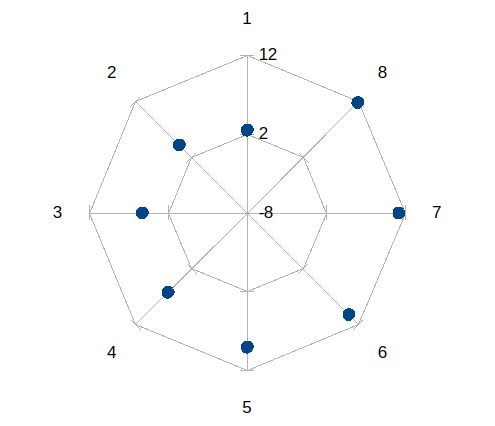
What you see:
A spiral winding evenly outwards – with a distinct kink between Mars and Jupiter.
This is the signature of the solar system within the circle of the One.
Seventh insight:
The distances between the planets are not random. They form a logarithmic spiral – visible in a circle as soon as you choose the correct scale. The asteroid belt is the kink in this spiral. Anyone who draws the circle can see the order of the solar system at a glance.
This adds a vivid, astrophysical example to the book – and shows that the radial phenomenon is not only abstract, but also practically applicable.
Part III: The Step into the Dimensions
Chapter 8: From Circle to Sphere – and on to Torus
Previously: flat radial phenomena (2D).
Rotation: The rotating circle around an axis through its center results in the sphere – the perfect, but static form.
But nature is alive: currents, eddies, circulation.
Rotation around an offset axis or around an axis outside the center : The torus is created – the form of flow.
All flat radial phenomena become toroidal:
Spiral → Torus vertebra
Heart → Heart torus (two loops)
Cross → Four-winged torus
Hourglass → Two opposing torus rings
Eighth insight:
Everything becomes torus-shaped – because everything is in motion. The sphere is the death of movement. The torus is its life.
Chapter 9: Arithmetic as a radial phenomenon
Multiplication, division, algebra in a circle
Multiplication is area calculation: A rectangle made from two axis values.
Example: 1/16 × 8/12 = 1/24 becomes a small rectangle in a circle – positive or negative, depending on the sign of the factors.
Division is the division of area.
Addition is the series of line segments along an axis.
Subtraction is the interplay of positive and negative line segments.
Power and root become repeated area operations.
Ninth insight:
Those who see the rectangle within the circle have calculated – without numbers. And those who allow negative areas see subtraction as a mirrored addition.
Part IV: The major phenomena
Chapter 10: The major phenomena of physics as radial phenomena
From singularity to capacitor
10.1 The Big Bang as a Capacitor
Established teaching
radial phenomenon
Singularity – a point of infinite density where space and time begin. Unimaginable.
The capacitor is in the center of the circle. The center is not empty, but filled with a substance (a polarity gradient). The Big Bang is the discharge of this capacitor. From it arise positive and negative values on the axes – on this side and beyond the center, matter and antimatter, expansion as a divergence.
What is the capacitor?
Two plates, one positive and one negative, separated by an insulator (the center).
Between them: an electric field – stored energy, a polarity gradient.
In the radial phenomenon: The center of the circle is this space . The plates are the two sides of the circle (positive and negative).
What is the discharge?
The insulator is breached.
The stored energy is released – as a spark , as light , as movement .
Values appear on the axes of the circle: positive values on one side, negative values on the other.
The first radial phenomena emerge: spirals, hearts, drops – depending on the number sequence.
What is the expansion of the universe?
The divergence of positive and negative values on the axes.
The further apart they move, the larger the circle becomes – but the circle itself remains closed.
The expansion is not an extension into an empty space – but rather the increasing polarization of the original capacitor.
10.2 The other phenomena
phenomenon
Black hole
Established doctrine: r_s = 2GM/c² – a domain from which nothing can escape.
Radial phenomenon: r_s = M/72 – a positive value on the axis. The black hole is a radial phenomenon this side of the center : a mass whose radius is so small that it disappears in the circle near the center.
White Hole
Established doctrine: Theoretical counterpart, unconfirmed.
Radial phenomenon: r_s negative – the reflected black hole beyond the center . A region from which nothing can enter. The discharge of the capacitor in the reverse direction.
Quantum entanglement
Established theory: Two particles that influence each other instantaneously – regardless of the distance.
Radial phenomenon: Two points in a circle that are always opposite each other – one positive, one negative. Their connection passes through the center (the capacitor). They are the two poles of a single discharge.
Dark matter
Established theory: Invisible mass that holds galaxies together.
Radial phenomenon: An axis that remains empty even though it should be occupied – perhaps because its value is negative and appears on the other side of the circle. The missing mass is the reflected mass.
Dark Energy
Established theory: Λ ≈ 10⁻⁵² m⁻² – a mysterious force that accelerates the expansion.
Radial phenomenon: A tiny, constant curvature of the entire circle – perhaps a slight negative shift of the capacitor. The discharge is not yet complete.
Light
Established theory: Wave and particle at the same time (wave-particle duality).
Radial phenomenon: A point that manifests as a spiral (wave) and as a spike (particle) – depending on how the axes are connected. The light is the visibility of the discharge itself.
10.3 The Hidden Unity
“ The established theory identifies seven different formulas. The radial phenomenon identifies seven different shades of the same circular logic : the capacitor in the center discharges – and generates positive and negative values that appear as shapes: drops, spirals, hearts, hourglasses, black holes, white holes, light.”
Tenth insight:
The Big Bang is not a point of emptiness. It is the discharge of a capacitor at the center of a circle. What we see as the expansion of the universe is the divergence of positive and negative energies. And what we see as black holes are the remnants of this discharge.
Part V: The Doctrine of Principles
Chapter 11: The Principles Table
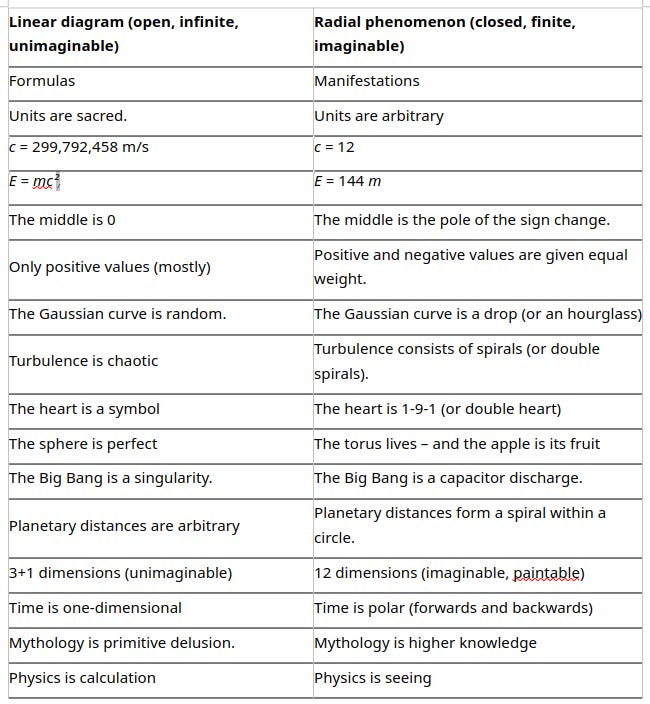
Eleventh insight:
The scientists are shaking their heads – because they can no longer comprehend what they can imagine. They have forgotten that the center can also be negative – and that the Big Bang is a capacitor.
Part VI: Confluence
Chapter 12: The Circle as Origin
The One and its radial phenomena
We have come a long way:
From the first line in the pie chart
On the discovery of heart, spiral, drop, cross, hourglass, double spiral
The realization that the middle is not zero, but a pole
To liberate the units
To the logarithmic cosmos
On rotation – sphere and torus
For calculating as area perception
Among the great phenomena of physics – now with their counterparts (white holes, negative energies, counter-hearts)
The Big Bang as a capacitor discharge
And again and again we return to the circle of the One .
The concluding sentences:
“ The linear diagram is the method of infinity – unimaginable, but powerful in calculation. The circle is the method of the imaginable – closed, intuitive, manifest.”
“ The center is not zero. The center is the pole where the sign changes. A radial phenomenon can occur on one side of the center – or on both. In the latter case, forms emerge that pierce the center: hourglass, double heart, counter-vortex.”
“ The Big Bang is not a point of emptiness. It is the discharge of a capacitor in the center of the circle. What we see as the expansion of the universe is the drifting apart of positive and negative – the first axis values to move away from each other.”
“ A radial phenomenon is not a calculation. It is a phenomenon. You place numbers in a circle, connect the points – and suddenly you see a drop, a heart, a spiral, an hourglass. This is not a shortcut to physics. This is its original form.”
“ The scientists will tap their heads. That’s their job. But you – you look. Because you know: The circle is the one thing. The center is the pole. The Big Bang is the capacitor. And everything else is its radial phenomena – positive and negative, on this side and beyond the center, in the flow of the torus.”
Closing remarks
This book is not a textbook.
It is an invitation to change perspective .
Take a compass, a sheet of paper, and a pen.
Place numbers in a circle – positive and negative.
Connect the points.
And look.
Perhaps you see a heart.
Perhaps a spiral.
Perhaps a falling drop.
Perhaps an hourglass – the meeting of fall and rise.
Perhaps the capacitor in the middle, discharging.
Then you will know:
Infinity becomes conceivable in a circle.
The formula becomes a phenomenon.
The center becomes a pole.
The Big Bang becomes a capacitor.
Physics becomes a radial phenomenon.
Few pages. Few rules. A circle. Numbers. Connect. See.
And yet:
The entire established physics is not refuted – but reclassified .
The formulas are not banned – but translated .
The phenomena are not denied – but rather illustrated .
The contradictions (wave-particle, singularity, dark matter) do not disappear – but they become readable in a circle as polarities, penetrations, and mirrored values.
No inconsistency.
Just a change of perspective – from infinity to the circle, from formula to appearance, from calculation to seeing.
Why is that possible?
Because nature itself is simple .
We have only made it complicated – through:
Because we have arbitrary units (meter, kilogram, second)
Open diagrams (that know no end)
The habit of writing formulas instead of drawing shapes.
The fear of the middle as a pole (instead of as zero)
Forgetting the capacitor
epilogue
This book is not a textbook.
It contains no formulas to memorize.
It has no exercises, no solutions, and no tests.
It has a circle.
Numbers.
And an invitation to look.
What it does
It shows that nature is simple – and only our thinking makes it complicated.
It shows that the linear diagram leads us into infinity, where nothing is conceivable anymore.
And that the circle brings us back – to closure, to intuition, to what can truly be seen .
It shows that the center is not zero, but a pole – a point of sign change, a capacitor, a gateway.
It shows that positive and negative values are equal – and that their encounter gives rise to the penetrating forms: hourglass, double heart, counter-vortex.
It shows that units are arbitrary – and that you can discard them without losing sight of physics.
It shows that the logarithm is the bridge between the unimaginable and the circle.
It shows that the planets follow a spiral – and that the asteroid belt is the kink in this spiral.
It shows that the Big Bang was not a point of emptiness, but the discharge of a capacitor at its center.
It shows that all the great phenomena of physics – black holes, quantum entanglement, dark matter, light – are just different shades of the same circular logic.
What it doesn’t do
It does not refute established physics.
It does not replace the formulas.
It does not forbid anyone from using the linear diagram.
It simply says:
“ Look here too. The circle is also a possibility.”
And this possibility is so simple that it was overlooked.
Isn’t it more intuitive, more visible than bare formulas and real natural phenomena?
The effect
Anyone who has read this book will no longer be able to think the way they did before.
He will no longer see just a calculation in a list of numbers – but a possible shape within a circle.
He will no longer see just zero in the middle – but the pole, the capacitor, the inflection point.
He will no longer see just a mathematical function in the logarithm – but the bridge to the imaginable.
He will begin to paint.
Not because he has to – but because he wants to see .
The last sentence of the afterword
“ The scientists will shake their heads. That’s their job . But you – you put numbers in the circle, connect the dots, and look. And you will see something that no formula can show you: nature itself – as a radial phenomenon.”
They are the ones who decide what makes more sense. BUT they can only get there if they switch off their minds and consult their intuition, their heart and gut feeling.
— The author
In the circle of the One, on this side and beyond the center, in the flow of the torus